Qadimah: A Stunning Islamic-Inspired Display Font for Handmade Creators
If you're crafting labels, designing wedding stationery, cutting vinyl for boutique tags, or building printable collections for Etsy — Qadimah is the kind of display font that makes your work feel instantly elevated. It’s not just decorative; it’s intentional. As a maker who prints on kraft paper, cuts stickers for artisan soaps, and designs digital planner pages with cultural resonance, I’ve tested dozens of fonts — but Qadimah stands out because it balances reverence and refinement in a way few display fonts do.
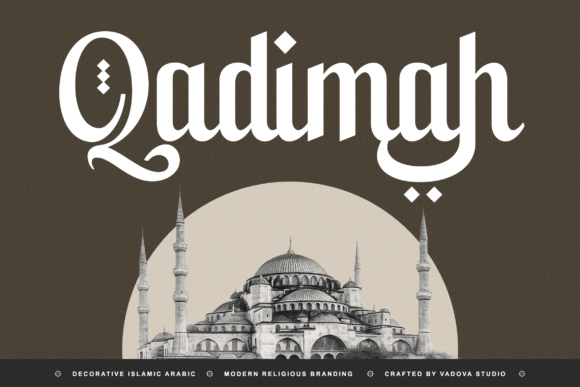
At its core, Qadimah is a decorative Islamic-inspired display font — but don’t let “Islamic-inspired” limit how you imagine it. Its letterforms draw from traditional Arabic ornamental motifs: elegant curves, teardrop terminals, subtle symmetry, and graceful spacing. Yet it’s built on a refined modern serif structure, meaning it holds up beautifully at larger sizes without feeling fussy or fragile. That duality is why it works so well across physical and digital products — whether you’re laser-engraving a wooden welcome sign or laying out a printable Ramadan wall art set.
For handmade sellers, readability and cutability matter just as much as beauty. Qadimah shines in short-form applications: product names, greeting card headlines, invitation titles, and boutique tags. Its open counters and generous x-height make it highly legible even at 24–36pt on printed labels or small die-cut stickers. I’ve used it successfully for candle jar labels (on matte kraft and glossy white), wedding welcome boards (cut from 1/8" birch plywood), and enamel pin mockups — every time, customers comment on the “warmth” and “intentional elegance.” Just avoid using it for body text or long paragraphs; it’s designed for impact, not endurance.
Here’s where Qadimah truly earns its place in your design toolkit:
- Wedding & event stationery: Use it for “Mr. & Mrs.” on foil-stamped invitations, or “Welcome” on acrylic ceremony signs — the serif grounding gives it gravitas, while the ornamental flow adds soul.
- Product packaging: Works beautifully on olive oil bottles, spice jars, and handmade soap wraps — especially when paired with a clean sans serif for ingredients or origin details.
- Digital printables: Perfect for printable wall art (“Bismillah,” “Alhamdulillah,” or bilingual quotes), planner headers, and faith-based affirmation cards.
- Cricut & Silhouette projects: Cuts cleanly at 1.5"–3" height on vinyl and cardstock. For smaller cuts (under 1"), simplify by turning off optional swashes or ligatures — most versions include alternate glyphs you can toggle on/off in design software.
- Seasonal & boutique merch: I’ve used Qadimah on Eid gift tags, Ramadan countdown calendars, and minimalist hijab packaging — always paired with soft neutrals or deep indigo to let the type breathe.
Font pairing is where Qadimah really sings. Because it carries strong visual personality, it pairs best with grounded, neutral companions. Try it with a warm, humanist sans serif like Quicksand or Poppins for product labels and social media graphics. For wedding suites, layer it over a delicate script font (like Brittany or Adorn Script) for names — then drop down to a simple serif like Playfair Display for details. The contrast creates hierarchy, clarity, and quiet sophistication.
Before you download, check what’s included: most Qadimah licenses offer OpenType features like stylistic alternates, discretionary ligatures, and multilingual support (including extended Latin and basic Arabic characters). That means you can fine-tune “A” and “Q” endings for smoother flow on signage, or swap in flourished capitals for premium packaging. File formats typically include .OTF and .TTF — both fully compatible with Cricut Design Space, Silhouette Studio, Canva Pro, Adobe Creative Cloud, and Microsoft Word.
Licensing is non-negotiable for sellers — and Qadimah is licensed for commercial use, which covers everything you need: physical product labels, SVG files sold on Etsy, printable templates, client branding work, and merchandise like mugs and tote bags. Just be sure to review the specific license terms — some versions allow unlimited sales, while others cap usage at a certain number of units per year. When in doubt, go with the extended commercial license. It’s peace of mind you’ll appreciate when your candle line lands in a local boutique or your digital Ramadan planner hits 500 downloads.
One practical note: test Qadimah in your actual production workflow before committing to bulk runs. Print a sample label on your exact paper stock. Cut a test sticker at your usual size and material. Preview your SVG in the machine’s preview mode — sometimes ornamental terminals need slight kerning tweaks at ultra-small sizes. And always embed the font in PDFs if you’re sending files to printers — it avoids substitution surprises.
What makes Qadimah more than just another pretty display font is how it supports your brand story. In a market flooded with generic scripts and overused serifs, choosing Qadimah signals intentionality — respect for tradition, care in craft, and attention to cultural nuance. Whether you're designing for a Muslim-owned tea shop, creating inclusive classroom printables, or launching a mindful lifestyle brand, this font helps your audience *feel* the values behind your work before they even read a word.
It’s rare to find a display font that’s equally at home on a hand-lettered welcome board and a sleek Shopify banner — but Qadimah bridges that gap with quiet confidence. If your next project calls for warmth, distinction, and quiet authority, give Qadimah space to speak. Then step back — and let your customers lean in.